Every step is something you can see happening. Nothing is decided behind a curtain.
01
Tell us your vehicle.
Year, make and model is enough to start. A VIN is better, and takes ten seconds off the door sticker.
02
Our AI verifies the correct part.
It checks the specific ways this part gets ordered wrong — drivetrain, transmission, trim, refrigerant type — and asks you the one question that settles it.
03
Compare your best options.
Economy, recommended and OEM, side by side, with the warranty and the wait time attached to each.
04
Approve your quote.
Nothing is ordered until a named human at the shop approves it and you say yes. That gate is a state machine, not a policy.
05
Schedule service or pickup.
Pick a window that works. You get the part's real arrival time, not an optimistic one.
06
Drive away with confidence.
Itemised invoice, warranty terms in writing, and the core deposit refunded when the old unit goes back.
The part you don't see
Most of the money is lost before anyone picks up a wrench.
Wrong part ordered. Right part, wrong trim. A rebuilt unit fitted when the fault was a ground strap.
The repair itself is rarely the expensive mistake — the decision in front of it is.
Four taps. No forms to fill in, no jargon to spell. This runs the real decision rules from our engine —
the same diagnostic gate, the same 16 fitment traps, the same confidence arithmetic. Sometimes the right
answer is “I need to look at it first,” and it will tell you so instead of selling you a part.
Makes we service. Brand names are used to describe the vehicles we work on; no affiliation or endorsement is implied.
Instant answer
What is that light on my dash?
Tap the symbol you're seeing. You'll get what it actually means and — the part nobody tells you —
whether it's safe to keep driving.
General guidance for common symbols, not a diagnosis of your vehicle. Symbols vary slightly between
manufacturers — your owner's manual is the authority for yours.
Services
What we fix.
Common repairs, priced the same transparent way every time.
Brake Service
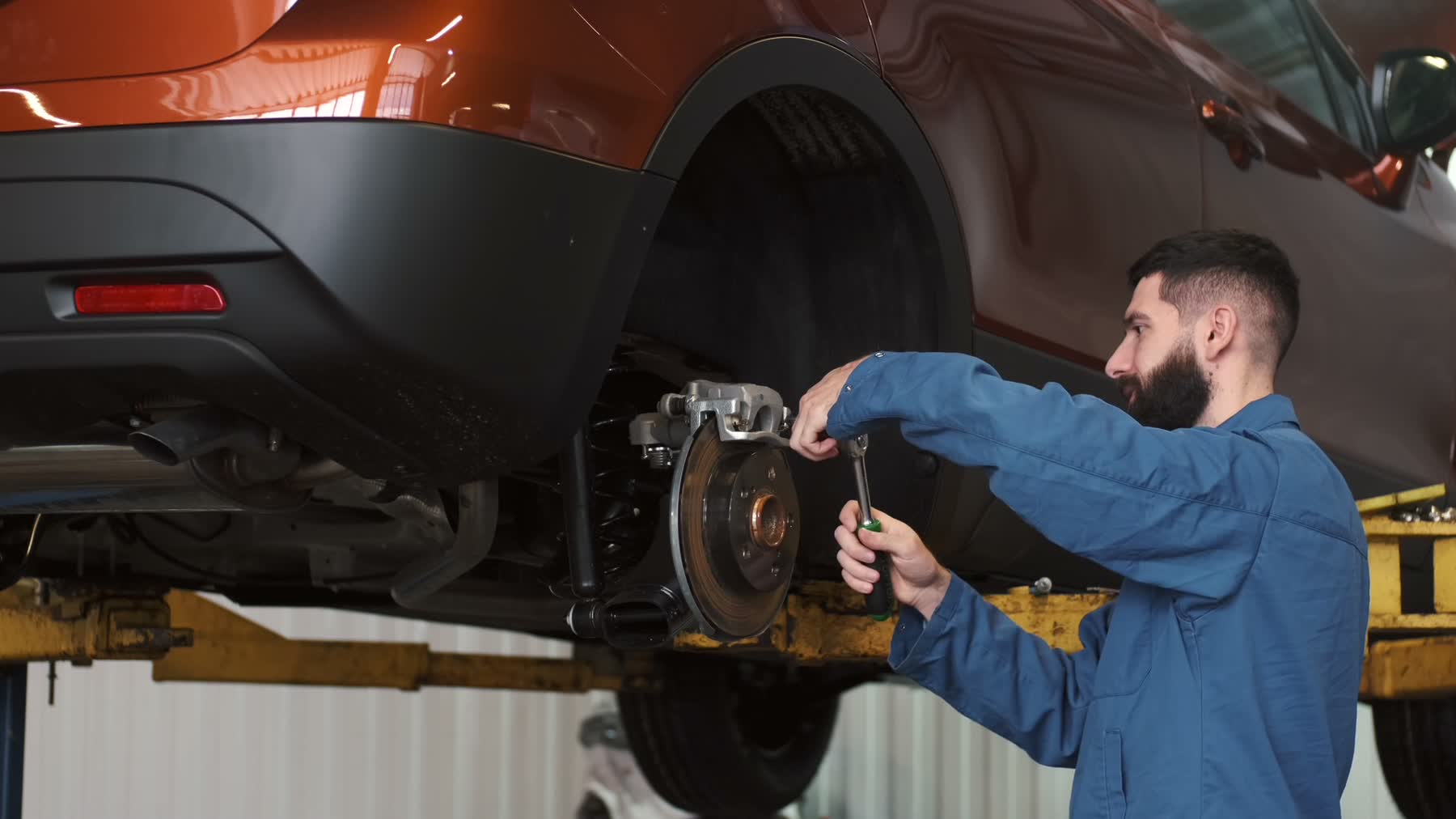
Pads, rotors and hydraulics. We confirm front or rear before anything is ordered — they're entirely different parts.
Rotor diameter varied within a single model year on several trucks and SUVs depending on the brake package. If we can't confirm yours from the VIN, we measure it before ordering rather than guess.
Alternators
Charging-system diagnosis first, part second. A low-amp unit will bolt straight on and then flatten your battery.
Output rating follows the options package — tow packages, dual batteries and heated-everything trims get a higher-output alternator. We ask about yours before we order.
Starters
A no-start is five different failures that sound identical from the driver's seat. We test before we sell.
Battery, grounds, starter, ignition switch, neutral safety switch. Replacing the starter when the fault is a ground is the single most common way people waste money on a no-start.
Batteries
Free load test at the counter. If the battery is fine, we say so and keep looking.
A load test settles a battery in two minutes and costs nothing. It's one of the few things where the customer really can hand us the answer.
Diagnostics
Scan, road test and a written finding. The fee is credited against the repair if you go ahead.
A check-engine light points at a stored code, not a part. We read the code, verify what it actually means on your vehicle, and tell you what we found before recommending anything.
Suspension
Struts, control arms, tie rods and bearings — diagnosed on the vehicle, because six parts make the same noise.
Wheel-bearing hubs differ between two- and four-wheel drive, and the ABS sensor is built into the hub on most modern vehicles — fit the wrong one and you trade a noise for a warning light.
Engine Repair
Cooling, timing, fuel delivery and drivability. Scoped in writing before a wrench moves.
Larger jobs get a written scope with the parts, the labor time and the assumptions stated. If we find something once it's apart, you approve the change before we continue.
Oil Changes
Correct viscosity and spec for your engine, with a genuine multi-point look — not a checklist of upsells.
You get told what we saw, including the things that are fine. Anything we flag comes with how urgent it actually is, so "soon" and "before you drive it home" don't sound the same.
Fleet Service
Multiple vehicles, one point of contact, approvals that respect your spend limits.
Named approvers with their own spend ceilings, so a routine repair moves without a phone call and a large one always reaches the person who should decide it.
Same-Day Parts Sourcing
Local wholesale, parts stores, dealer and salvage compared at once — including who actually has it today.
Suppliers are scored on how often they send the right part first time and how painful a return is. A cheap supplier with a history of wrong shipments gets priced accordingly, automatically.
Why PartPilot AI
The difference is what happens before the part is ordered.
Traditional shop
—Waiting
—Phone tag
—Guesswork
—Limited inventory
—One price, take it or leave it
—“We'll call you when it's ready”
PartPilot AI
✓Instant responses
✓Verified fitment before ordering
✓Transparent, itemised quotes
✓Multiple supplier options
✓Digital updates
✓Professional installation
One thing worth saying plainly. PartPilot refuses to quote roughly seven out of ten
same-day parts requests until something has been tested or diagnosed. That is a deliberate trade: it costs the
shop faster sales, and it saves you from buying a part you didn't need.
Trust
Proof, once it's real.
These panels are deliberately empty. Reviews, statistics and certifications belong to the shop that earned
them — writing placeholder praise here would undo the exact thing this page is built to demonstrate.
Slot · testimonials
Customer reviews
Drop in real quotes with first name, vehicle and month. Three is plenty.
Slot · google
Google rating
Live rating and review count, linked to the Google Business Profile.
Slot · warranty
Warranty terms
The actual parts-and-labor warranty, in writing, per supplier tier.
Slot · gallery
Before & after
Real repair photos. Six to eight, shot on a phone, no stock imagery.
Slot · credentials
Technician certifications
ASE certifications by technician, with the year attained.
Slot · numbers
Business statistics
Years serving Decatur, vehicles repaired, average turnaround. Verifiable ones only.
Straight answers
The questions we actually get.
Including the uncomfortable ones. If the honest answer costs us a sale, it's still the answer.
Do you charge for a quote?
No. Requesting a quote, receiving one and declining one all cost nothing. You owe
money when you authorize work or ask us to order a part. If a repair needs diagnostic time before
anyone can price it, we tell you the diagnostic fee up front — and it's credited against the repair if
you go ahead.
Why won't you just tell me what a starter costs over the phone?
Because a no-start is five different failures that sound identical from the
driver's seat: the battery, the grounds, the starter, the ignition switch or the neutral safety switch.
Selling you a starter before anything is tested is a coin flip you pay for. Our engine refuses to price
a part for that symptom until a test result exists — about seven in ten same-day parts requests get
refused on this basis. Once it's been tested, the price comes back in seconds.
What is a core charge, and do I get it back?
Many rebuilt parts — alternators, starters, calipers, some pumps — carry a
refundable deposit on the old unit, because the supplier wants the old one back to rebuild. It's a
separate line on your quote, never buried in the part price. You get it back when the old unit goes
back in returnable condition, typically within 30 days of the new part arriving. If the old part is
damaged past the supplier's criteria, it isn't refundable — and we tell you that at the time, not at
the end.
Can I bring my own part?
Usually, yes. Two things to know: we warrant our labor but not a part you
supplied, so if it fails, the repeat labor is chargeable. And we may decline to fit a part where doing
so would be unsafe. If you already bought the wrong part, tell us the number — checking it costs
nothing and is a lot cheaper than finding out on the lift.
Do you need my VIN?
No, but it's the single most useful thing you can give us. Year, make and model
is enough to start. The VIN is what removes almost every follow-up question — engine, drivetrain, trim
and brake package all decode from it, and those are exactly the details that decide which of four
similar-looking parts actually fits. It's on the driver's door sticker and at the base of the
windshield.
How long is a quote good for?
Seven days, unless the quote says otherwise. Parts pricing and availability move
genuinely fast — a supplier who has it this morning can be out of stock by the afternoon, so we'd
rather re-check than honour a number we can no longer buy at.
What if the final bill comes in higher than the quote?
If the invoice would exceed the approved amount by more than 10%, we stop and
get your authorization again. That isn't a courtesy — it's enforced in the software and in the
database, so it can't be skipped on a busy day. If we find something once the vehicle is apart, you
hear what we found and what it changes before we continue.
Is the labor on my bill taxed?
Not by us. Georgia doesn't tax separately stated repair and installation labor,
so we don't charge tax on it — which is exactly why labor is always its own line rather than folded
into a lump sum. Tax applies to parts and taxable materials, and it's a pass-through: we collect it
and remit it, we don't mark it up.
My check engine light is on. Is the car safe to drive?
If it's steady, usually yes for a short while — get the code read soon. If
it's flashing, stop driving. A flashing check-engine light generally means a misfire that can
destroy the catalytic converter within minutes, turning a small repair into a large one. The light
points at a stored code, not at a part; the code tells us where to look, not what to sell you.
Is an AI deciding what my car needs?
No. The AI handles the conversation and the arithmetic — decoding the VIN,
checking known fitment traps, comparing suppliers, assembling the quote. Every decision that touches
your money or whether a part fits is made by fixed rules, not by a language model, and no part is
ordered until a named person at the shop approves it within their own spend limit. The AI cannot
approve its own purchase. That's structural, not a setting.
Book
Get my quote.
Four steps, about ninety seconds. A person reads every one of these.
1 · You2 · Vehicle3 · Problem4 · Review
Photo upload and deposit payment are on the roadmap and deliberately not shown here yet —
see the site README for what is and isn't wired.
Coming to your account
Your repair, not a mystery.
A preview of the customer dashboard. The panel below is a design preview and is not showing anybody's real
vehicle. The shop console behind it is real — sign in with Google, and an operator grants your account
access to a shop.